
If you’re one of the lucky few living in a state that mandates insurance coverage of fertility treatments, or whose company provides benefits to help with the massive associated costs, you have a leg up on most people who are considering fertility treatments right now.
Fertility treatments are SO EXPENSIVE. Staggeringly so. I’m not going to quote the statistics because chances are, you’re already painfully aware. You’re probably looking at the statements on your countertop and feeling panicky about how you’re going to afford them.
But when you want a baby and this is your best (or only) option, you’re going to do anything you can to figure it out.
So the question is: Other than maxing out your credit cards, or putting your home equity or 401k value on the line, how in the world are you going to pay for this?
Last year, we ran a post about grants and scholarships for fertility treatments. I think these are a great option if you can find one that’s a good fit for you. It’s worth taking a look at the list, and then doing some research on your own to check out other programs that we may have missed.
But I also know that whenever there is a hurdle as big as this, people out there are getting super creative with how to leap over it.
Here are some other ways that people are paying for some or all of these insane medical costs:
1. Medical Tourism
You’ve probably heard of people travelling overseas to save tons of money on expensive surgeries.
Well, medical tourism isn’t just for surgery – its a real option for fertility treatments, too. According to Patients Beyond Borders, almost 1.5 million Americans traveled to a foreign country last year to save money on a medical procedure, and savings can range anywhere from 20% to 90%. (source)
It’s possible to pay less to go abroad for IVF—even after you include plane tickets and hotel—than go down the street.
Where can you go? There are a lot of options, and costs and considerations vary widely. Fertility Treatment Abroad is one place to start – the site lists costs and government requirements for the top IVF medical tourism destinations worldwide, which includes:
- Ukraine
- Turkey
- Lithuania
- Hungary
- Czech Republic
- Greece
- Spain
- India
- Denmark
- Barbados and Grand Cayman in the Carribean
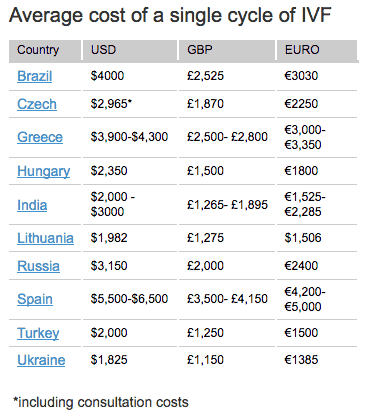
If you’re thinking about travelling to save money on fertility treatments, you’ll want to look at more than just the cost of a single IVF cycle. Other factors to consider include: travel and accommodation costs for potentially multiple visits, the native language, local fertility laws and governmental bodies, and your personal and emotional comfort in the location.
2. Crowdfund It
You’ve seen GoFundMe pages to support everything from educational costs to funeral costs to extravagent vacations. If you can get comfortable with the very public nature of online funding campaigns, a crowdfunding site may be a good option for you.
GoFundMe even has a whole page dedicated to helping people set up campaigns for IVF. It shows couples who have successfully raised thousands of dollars to help with the costs of their fertility treatments.
Go in with your eyes wide open, though. This approach requires you to publish your personal story for everyone and anyone to see. These campaigns take a lot of time and focus, and having an extensive social reach helps a lot. Creativity may go a long way, too, in convincing donors to give (I’ve seen GoFundMe campaigns that offer specific prizes for different funding levels: If you give $30, you get a signed book, while a $100 donation gets you tickets to a Broadway show).
If all of that sounds do-able and worth it to you, it can be a powerful option for raising money. Just check out some of GoFundMe’s IVF success stories like this one.
3. Sell Your Stuff
Any chance you have a priceless antique in your attic? Or a valuable piece of sports memorabilia that you’d be willing to part with for the right price? A Huffington Post article told the story of a couple who had a “double-signed Barry Sanders and Walter Payton football memorabilia card up for sale to pay for their treatment.”
Just think about it. And maybe do some digging in those old boxes.
4. Host a Chili Cook-Off
This is taking is old school, but think about how much money those PTOs make with their bake sales and car washes. There’s a reason they keep doing them year after year, right?
Love to cook? Sell your best cookies or specialty birthday cakes. Or host a chili cook-off with requested donations.
Have a ton of stuff in your basement and garage that’s just collecting dust? (Honestly, who doesn’t?) Make sure it’s not unexpectedly valuable first (see #3 above), and then hold a massive yard sale!
Start a 5K race in your neighborhood with entrance fees to be donated to your cause.
Think about your skills and interests, and then consider if there’s a way you could bring your community together to support your personal cause.
5. Become a Starbucks Barista
If your company doesn’t have the greatest fertility benefits, consider changing jobs to one that does.
Believe it or not, Starbucks is a pioneer in fertility benefits. CBS News reported: “Starbucks covers $20,000 for IVF and related medication for all eligible employees. That includes part-time baristas who make, on average, about $10,000 per year.”
If you’re not excited about the idea of slinging lattes part-time, there are currently more than 400 US businesses and organizations had policies in place to cover the cost of IVF. These include:
- ExxonMobil (70,000 employees)
- Procter & Gamble (95,000 employees)
- AT&T (273,000 employees)
- Liberty Mutual (50,000 employees)
- Tyson Foods
- Northwestern Mutual
- General Mills
- Geico
- Bain & Company
- Boston Consulting Group
- Bank of America
- Tesla
- Intel
- Lyft
- Stripe
- Square
- Stitchfix
- Chobani
Learn more with this list from FertilityIQ that identifies many of fertility-friendly companies and the benefits they offer.
6. Nickel and Dime it
This one might be the least exciting of the bunch, but it’s a legitimate approach to taking control over you ability to pay for pricey fertility treatments.
Take a detailed and thoughtful look at all of your own finances and the potential financial implications of the treatments you’re considering, and then tackle every possible option for reducing costs and maximizing your personal income and savings.
This approach could include:
1. Getting Serious About Your Budget
There are all kinds of resources (online, books, podcasts, etc.) about managing your budget. At Creating a Family, several people shared ideas for “serious budget trimming to increase their ability to save money for out of pocket expenses. Jennifer and her spouse stopped eating out for eight months and reduced their spending money by 25%! Many members mentioned cutting entertainment or vacation expenses for the time in which they were saving for treatment. Still others chose to live “below their salary,” drive used cars, and use any extra income like bonuses or tax refunds specifically for treatment costs.”
2. Pay Less for Fertility Prescriptions:
Fertility-related medications can be incredibly expensive. But it is possible to pay less simply by asking, or researching your options:
- Some pharmaceutical companies offer discount programs and mail-in-refund programs for their fertility drugs, including:
EMD Serono (maker of Gonal-F)
Ferring Reproductive Health (maker of Bravelle, Menopur, Endometrin, and Novarel) - Tell your clinic that you want to consider less expensive medication options first – they won’t know your needs unless you tell them.
- Some clinics have medications turned in by past clients that they can donate to current patients.
- Shop around at different pharmacies to comparing pricing.
3. Take Advantage of Federal Tax Reimbursements
Costs associated with infertility treatments can be tax-deductible – if you know how to ask for it. Inform your accountant of your costs.
4. Use your Pre-Tax HSA or FSA
Even if your insurance doesn’t pay for your fertility treatment costs, a pre-tax Health Savings Account or Flexible Savings Account often can be used for these medical costs, which will save you the tax-value on that income.
5. Compare Treatment Costs and Negotiate
Not every clinic will change the same. Explore several options, and take a close look at what is included in the pricing (ultrasounds, blood work, travel expenses, etc.), so you can make a fully-informed decision about your cost commitment. Ask every clinic about possible discounted treatment packages – many of them have options like this.
6. Make the Most of Your Insurance Plan:
Even if your clinic doesn’t take insurance, or if your insurance says they don’t pay for ART, you still have options. Look into:
- Submitting for reimbursement yourself if the clinic doesn’t.
- Read all the fine print of your plan. Even if IVF itself isn’t covered, some parts of your treatment may be, such as ultrasounds or blood work.
- Talk to your company’s HR representative about other less-known company benefits that could help in your situation. Or consider requesting that the company add a fertility benefit. If they hear the request from enough employees, they may do just that.
If you’re still thinking that swiping your credit card or applying for a loan might be the best option for you, take a look at RESOLVE’s comprehensive online guide to infertility financing programs.
Whether you’re facing $5,000 or $50,000 (or more!) in costs, figuring out a plan for how you can meet those financial demands will go a long way in helping you to stay focused on the medical and mental journey ahead, and keeping a positive mindset for moving ever-closer toward your end goal.
Get help managing the stressful emotional experience of infertility by using Circle + Bloom’s guided meditation programs. Try our Free Introductory Relaxation for Fertility to see how well it works for you, and then get more targeted support with our programs for Natural Fertility, IVF and IUI, PCOS, and Frozen Embryo Transfer.
With love & gratitude,







Thanks for the shout out! We have many great resources for reducing the cost of fertility treatment and for maximizing insurance coverage!