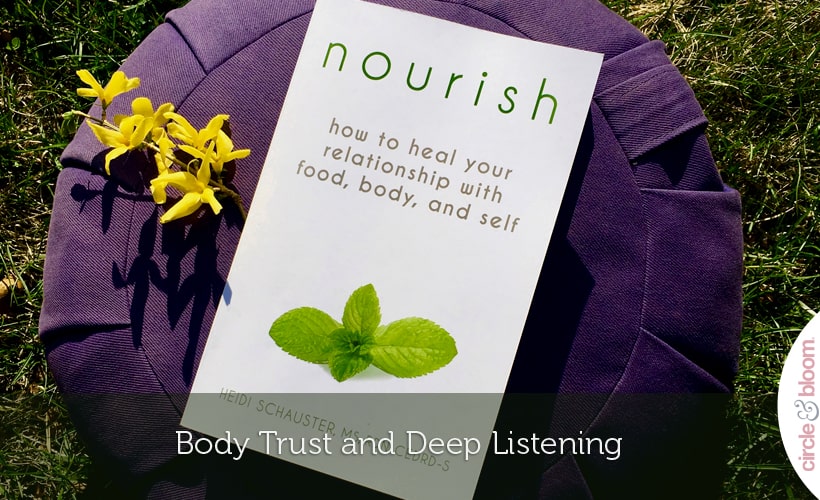
Guest blog by Heidi Schauster, MS, RDN, CEDRD-S, founder of Boston-based Nourishing Words Nutrition Therapy. This blog post is an excerpt from her new book Nourish: How to Heal Your Relationship with Food, Body, and Self.
Body Trust and Deep Listening involves developing a deeper connection with your body so that you can use that connection to make choices around food, exercise, sleep, and other practices and habits that resonate with who you are. Body trust and deep listening encourage care for your body and being.
On the most basic level, if you wish to cultivate deep listening and body trust, you must first slow down. I mean s.l.o.w. … d.o.w.n. … We are not typically encouraged to do this in our fast-paced do-it-all-and-then-do-more culture. Presence in our bodies and our lives brings consciousness, and consciousness creates the space for change.
If we don’t take the time to listen and actually hear what our bodies are trying to tell us—hunger, fullness, pain, tiredness, restlessness, cravings, nervous flutterings, other sensations—we miss out on a form of communication from which we might learn so much. This communication truly helps us to make decisions that bring us to live more abundant, full, and meaningful lives. Through our bodies, we get in touch with our deepest needs and feelings. When we have that connection and awareness to our needs and feelings, then we are better able to meet them. When our needs are more readily met, then we have a stronger chance of being able to help and support other people we care about as well.
I used to believe that being a martyr and serving all above myself was the road to enlightenment. I’ve learned the hard way (and so have many of my clients) that the most loving act you can offer those you care about is to love, respect, and care for yourself first. In doing so, you bring freedom and spaciousness for connection, compassion, and the blossoming of deeper, more caring relationships. This self-care takes practice if you weren’t trained this way from a young age, but it’s possible to learn. You will transform yourself and your relationships in the process. I believe that we need to use our minds to grow and change, but we also need to listen to the wisdom of our bodies and the feelings housed in our bodies—particularly if we want to find a more easeful, nourishing relationship with food and other health practices.
I believe that compulsive overeating, restrictive eating, or eating obsessively “clean” can be a way to reward and take care of a self that is repeatedly put last. So, how do we begin to take better care of ourselves, learn how to get in touch with the body’s wisdom, and s.l.o.w. d.o.w.n.? First, I must put in a plug for meditation practice. There are many ways to meditate, and there are countless books and audio files on meditation. I have taken courses, listened to recordings, and tried many different forms of meditation, and I encourage you to explore what works for you. Personally, I made meditation a daily practice (and, therefore, found the profound benefits of it) only when I committed to practicing ten minutes of insight-oriented meditation every day.
I had to let go of needing to do it for longer. I had to let go of doing it every morning. I stayed with it only if I committed to doing it every day and could fit it in whenever my day allowed it. I also had to let go of the resistance that I had to meditation and realize that the resistance is also a piece of learning. I had to let go of the part of me that wanted to do it perfectly and find a way to accept my distracted monkey mind. Sometimes I allow myself more stillness and reflection than ten minutes, but I allow myself a practice of pure presence every day. I finally got to a point where I decided that I deserved ten minutes just to be (and not do) every day. If I couldn’t cultivate that, then how could I teach others to listen deeply and be present in my work?
Once I made that daily commitment to meditation, I could not believe the results. Of course, I had heard everything about it being relaxing—creating more calmness and less anxiety— which sounded great. I had no idea that it would improve my life in so many other ways. I felt like a fog was slowly lifting. I could see more clearly during so many moments each day. I became more in touch with myself, my decisions were easier, my self-doubt decreased, and I stood up for myself more. I felt more compassion for my shortcomings and was able to work on them with humility. I was even more loving and present for my family and friends.
Now, mind you, everything isn’t always hunky-dory. In some ways, meditation practice has allowed me to feel more of life’s fullness, which means the downs as well as the ups. When I’m sad about something, I get more in touch with that in the quiet space on my cushion. When I’m angry, I feel that come up and, as a result, may choose to confront the person involved. That part’s not so fun. I’m more in touch with my feelings, so I express them more. Some people in my life welcome that, and sometimes it creates waves. If the other person is also aiming to be honest and present, that can occasionally be messy. Sometimes it’s beautiful, vulnerable, and connective, and we arrive at a deeper, more respectful place. Sometimes it’s just messy. But I know that my own meditation practice has helped me with something I call discernment: A stronger understanding and clearer ability to make decisions about others and my surroundings. And it’s also helped me to be far more present in my life and relationships.
Meditation practice also forces me to get in touch with my body. I notice if I feel tired or fatigued, or if there is a twinge in my leg that is telling me to be gentle when I’m dancing later in the day. I notice if there is anxiety because I feel it in my head and chest. I notice if my heart feels heavy. I notice if my body feels light and energized and how that’s different from the day before. I don’t judge or ascribe meaning to these changes. My mind mightily tries to, but I try to gently thank my mind for its concern and move back to my body and to clear presence. I have to do this over and over and over again. I notice that, when I’m tired, I have to do it more. I notice that, when I’m exhausted, I can barely find that quiet, present place. (No wonder I don’t relate to my family the way I want to when I’m exhausted!)
So, what if you hate your body so much that the idea of getting more in touch with it is terrifying or uncomfortable? One of my clients shared with me that, in meditation and in physical exercise (she’s beginning to practice both), she notices how uncomfortable she feels with the fat on her body. Another client who wishes to gain weight gets in touch with how weak her muscles feel and how sore her body feels just sitting still. Both of these women feel lousy when they get in touch with their bodies. As difficult as these feelings are, they are important body messages. Ideally, we respond to these feelings with compassion and acceptance. Only then, from a place of nonjudgmental, kind regard, can we decide how best to care for our bodies as they are.
Sustainable change sprouts from compassion and not loathing. I have seen this over and over and over again in more than two decades of practice, and I just can’t say it enough. If you don’t feel that you can deeply listen to and find acceptance with your body, I would recommend finding a body-positive, Health-At-Every-Size® psychotherapist, nutrition therapist, or coach if you need some help and support here.
I invite you to get quiet, deeply listen, trust your body, and use your internal cues and sense of well-being to help you make decisions about food, rest, sleep, exercise, and other self-care practices. I invite you to be very interested in what your body is telling you. We are distracted and disconnected so easily. Pay careful attention to the wisdom of your very own body.
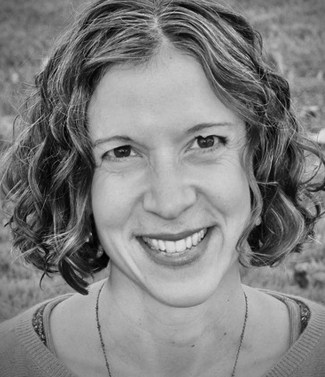 Heidi Schauster, MS, RDN, CEDRD-S, founder of Boston-based Nourishing Words Nutrition Therapy, is a certified eating disorders registered dietitian and supervisor with over 20 years of clinical practice, as well as her own recovery history. Heidi is the author of Nourish: How to Heal Your Relationship with Food, Body, and Self. She is a Health-at-Every-Size (HAES) practitioner who believes in weight-inclusive wellness and diet culture liberation. A lifelong dancer and proud mama of twin 12-year-old daughters, she can sometimes be found in the throes of a dishwashing dance party or digging around in her gardens. If you’d like to read more about body trust and healing your relationship with food, body, and self, please check out Heidi’s book Nourish, available at www.anourishingword.com/the-book/, as well as Amazon and Barnes and Noble.





Leave a Reply