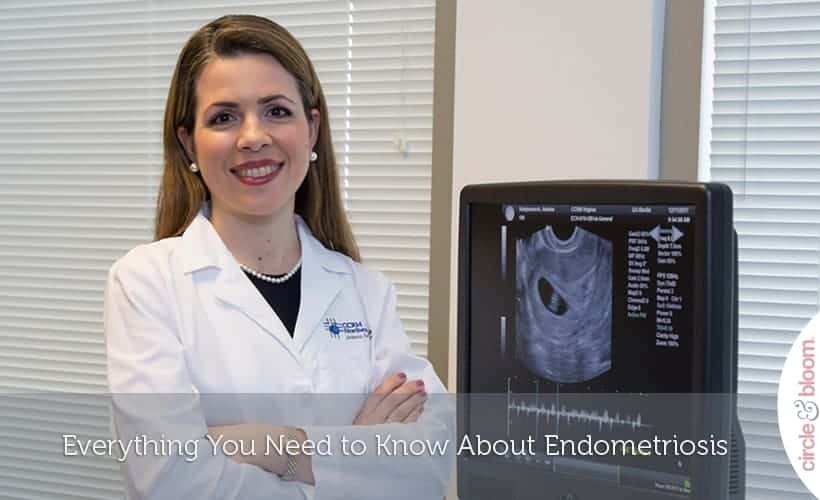
Guest blog by Dr. Vasiliki Moragianni, board certified in reproductive endocrinology and infertility, as well as obstetrics and gynecology. She is an Assistant Professor of Medical Education at the University of Virginia School of Medicine.
March is endometriosis awareness month around the world and our mission is to raise awareness of a disease which affects over 150 million women, as well as their partners and families, worldwide. Given the very high prevalence of endometriosis you are sure to know someone, maybe even yourself, affected by it. So here are answers to some common questions related to endometriosis.
1. What is endometriosis?
The tissue that normally lines the inside of the uterus is called endometrium. The endometrium is designed to respond to cyclic hormonal changes by getting thicker, breaking down, and then bleeding with each menstrual cycle. When endometrial tissue grows anywhere other than the inside of the uterus the condition is called endometriosis. The displaced endometrial tissue still responds to cyclic hormonal changes by bleeding but because there is no outlet for the blood it can lead to pain, inflammation, scarring, and fallopian tube blockage. Endometriosis can be present in the form of small spots (implants) anywhere in the body, or ovarian cysts called endometriomas.
The implants can be seen during surgery or they can be microscopic, and they can be found anywhere from the outer surface of the uterus, the ovaries and fallopian tubes, all the way to (rarely) the lungs and brain. They can lead to local tissue irritation and inflammation, eventually creating bands of scar tissue or adhesions that can cause pain, and infertility.
The endometriomas can be seen on pelvic ultrasound or during surgery and they contain a characteristic “chocolate”-colored fluid. Similar to endometriotic implants, they can also cause pain and infertility.
Endometriosis can affect women of any age, spanning the range from adolescence to menopause.
2. What are typical symptoms of endometriosis?
The severity and type of symptoms caused by endometriosis vary a lot between patients. Additionally, the severity of endometriosis does not always directly correlate with the severity of symptoms, i.e. patients with very severe symptoms might have no obvious implants or cysts at the time of surgery, whereas patients with severe disease might have no symptoms.
Typical symptoms include pelvic pain, that can be continuous or cyclic (painful periods), painful intercourse, bowel movements, or urination, heavy menstrual bleeding, fatigue, gastrointestinal symptoms (diarrhea, constipation, nausea, bloating), and infertility.
Women with endometriosis can certainly get pregnant on their own. However, 20-40% of patients with infertility have endometriosis. Endometriosis can cause infertility by blocking the fallopian tubes, causing pelvic inflammation, or compromising the ovarian reserve.
Additionally, even though endometriosis is a benign (non-cancerous) condition, patients with endometriosis are at increased risk of developing certain types of ovarian or extra-ovarian cancers.
3. How is endometriosis diagnosed?
Endometriosis can be suspected based on clinical symptoms but cannot be confirmed until an endometrioma is visualized on pelvic imaging (ultrasound, MRI, or CT scan), or implants are seen during abdominal surgery (laparoscopy or laparotomy). Not every patient with suspected endometriosis needs to undergo surgery.
4. What is the treatment of endometriosis?
The treatment of endometriosis is guided by the severity and type of symptoms, as well as the reproductive needs of the patient. In general, treatment includes medical and surgical approaches.
Medications that can help with symptoms typically target the cyclic hormones that “flare up” the disease and aim at keeping them low and suppressed throughout the month. Examples include hormonal contraceptives, progestins, aromatase inhibitors, and Gonadotropin-releasing hormone (GnRH) agonists and antagonists.
Surgical approaches can range from conservative and fertility-sparing (such as ablation of endometriotic implants, or endometrioma cyst resection) to hysterectomy and removal of the ovaries for patients who have completed childbearing.
In conjunction with these treatments, endometriosis patients can benefit from emotional support, acupuncture, and lifestyle modifications.
For more questions about endometriosis or fertility in general please contact Dr. Moragianni, an award-winning reproductive endocrinology and infertility specialist at CCRM Northern Virginia.
Dr. Vasiliki Moragianni is board certified in reproductive endocrinology and infertility, as well as obstetrics and gynecology. She is an Assistant Professor of Medical Education at the University of Virginia School of Medicine.
She received her undergraduate degree from Cornell University, followed by a master’s degree from Georgetown University. Dr. Moragianni received her medical degree from Drexel University College of Medicine and completed an OB/GYN residency at Abington Memorial Hospital in Philadelphia. Following her residency, she completed her Reproductive Endocrinology & Infertility fellowship at Harvard Medical School / Beth Israel Deaconess Medical Center, where she accepted a faculty position after fellowship. Dr. Moragianni has worked in private practice since 2012, and in 2017 she joined CCRM Northern Virginia.
Dr. Moragianni has been voted as a Top Doctor by the Washingtonian in 2018, as well as Top Obstetrician/Gynecologist by the International Association of Obstetricians & Gynecologists in 2013 and by the Consumers Research Council of America in 2014 and 2016. A native of Greece, Dr. Moragianni speaks Greek, French, and Italian (basic). She deeply cares about her patients and makes herself available to them as a healthcare partner and advocate in their journey towards parenthood.




Leave a Reply