
Guest blog by Keegan Prue, an educator and author of The IVF Dad.
I hoisted the bags out of the trunk and headed toward the back door. I hadn’t planned to stop for groceries on my way home, but driving to work that morning I’d heard a guest on a fertility podcast talk about how she believed going gluten-free helped her conceive and have a healthy baby. A bit of Googling later, I was hook-line-and-sinker convinced that eliminating gluten had to be the magical key to a successful pregnancy for my wife Olivia and me.
I spread my purchases out on the kitchen island: gluten-free crackers, cereal, and cookies. It was a bonanza! I started to boil water for some of the (gluten-free, of course) pasta.
A few minutes later, Olivia arrived home. She walked into the kitchen and looked at the mountain of boxes and bags on the island. She wrinkled her nose and furrowed her eyebrows.
“Um…what is all this?”
I must have looked slightly wild-eyed as I excitedly explained to her all the articles I’d read that day.
Blinded by my excitement, I barely noticed her growing look of concern.
“But…this all looks gross, and I already feel like crap from these stupid medications without having to eat bland crackers… we barely eat any gluten to begin with, neither of us has Celiac or a sensitivity, and this is the craziest thing I’ve ever heard! I’m going upstairs to change. And if gluten-free pasta is the only thing on the menu, then I’ll have something else.”
As Olivia climbed the stairs, I slunk toward the stove with my tail between my legs. I tossed out the pot of gluten-free pasta and looked for something else to cook. She was working so hard for us already—how had I let myself get so wrapped up in this gluten-free thing?
——
As this story from early in our infertility journey shows, I had a lot to learn about how to be a supportive partner to my wife. Even though my concern came from a good place—a place of just wanting to do anything possible to help in our quest to have a baby—I was so quick to act that I didn’t think of what my wife Olivia wanted, or what would be most supportive to her. Worst of all, I ended up adding to her stress when we all know that trying to conceive can already be stressful enough.
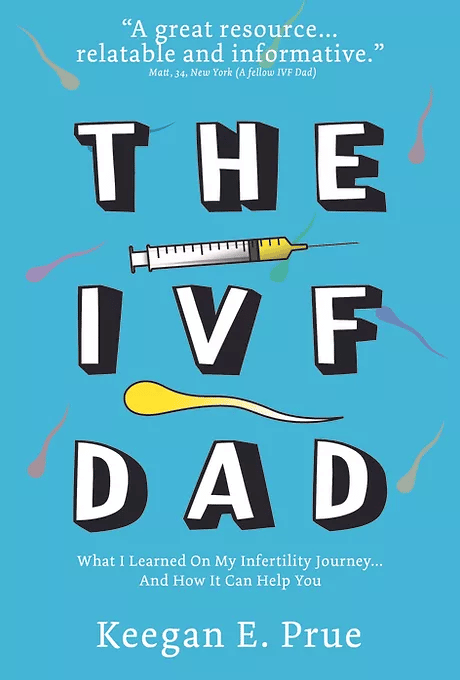
Fortunately, over the subsequent few years, through lots of communication and effort, I got the hang of things. I even wrote a book about our story and experience, The IVF Dad, to help men and couples support each other better through infertility.
Society doesn’t always do the best job of preparing or encouraging men to be sensitive and supportive of their partner’s emotions, but we are all capable of learning and growing! Infertility can be difficult on a relationship, and men should view it as an opportunity to become more empowered and supportive partners.
But how do you do that? Where do you start? Here are five simple tips men going through infertility can use to be more supportive.
Tip 1: Sometimes just being there to listen is the best support you can give—you don’t always have to fix things.
As my “glutengate” efforts above show, men are often tempted to try to fix things and take action (because that’s what society often tells us our role “should be”). But the reality is, during infertility, there is so much outside of our control. Furthermore, it’s natural to experience feelings of grief and sadness during such a difficult experience.
Rather than trying to cover over or fix things when you and your partner are having a difficult day or moment, try just being there to listen.
Instead of saying things like “Don’t worry, I’m sure this next treatment will work,” (which minimizes her feelings, and can’t be guaranteed) or rushing into action like I did with the gluten, practice just listening to your partner. Hear what’s she’s saying and how she’s feeling. Give yourself permission not to have to react or make a suggestion, but simply to say something like: “I hear how difficult this is for you. I’m here for you and I love you.”
Tip 2: Show your partner gratitude in small ways every day.
With the additional strain infertility brings, it can be easy to forget to show our partner how much we appreciate them. In many cases, they’re taking shots, going to early morning monitoring appointments, doing daily ovulation predictor strips, or any of a bunch of other extra efforts to help our cause of having a baby.
We often think of big gestures to show gratitude, but it can be just as effective to show gratitude in small ways every day. This can be as simple as:
- Taking some extra chores around the house to give your partner relaxation time
- Saying “thank you” for the small acts your partner does every day to support your relationship—even “little things” like doing the laundry or walking the dog
- Getting a nice card, writing a love note in it, and giving it to her for no particular reason on a random Tuesday
- Bringing home a special treat you know she loves, or plan a hike or dinner out
Tip 3: Be involved and show interest: learn about fertility treatments and attend appointments where possible.
Infertility comes with a ton of acronyms and information—if you’re early in the journey, you may still be wondering what IVF is vs. IUI, and where ICSI or AMH fit into it all! I spent a lot of time reading blogs and listening to podcasts early in our journey to familiarize myself with possible diagnoses, treatments, and other information, and it really helped me feel involved in discussions with Olivia. It also meant we were both well-prepared to participate in discussions with our reproductive endocrinologist, which ensured we got all the information we needed and all of our questions answered thoroughly at each appointment.
Which leads to the second part of this tip—attend appointments wherever possible! This doesn’t mean you need to go to every single blood draw, of course. But if you’re having a discussion with a doctor about a treatment plan, or debriefing a treatment cycle, or certainly if your partner has a procedure like an egg retrieval or embryo transfer—make a point to be there and show your support if at all possible.
Tip 4: Do your part during testing and diagnosis—get your semen analysis!
According to the Cleveland Clinic, male factor infertility may play a role in as many as 50% of infertility cases. Checking the health of your sperm is critical to making a well-developed treatment plan that gives you and your partner the best shot at success. So regardless of where you are in your infertility journey—if you haven’t gotten your semen analysis, schedule it as soon as possible.
Tip 5: If you’re really stuck on how to be supportive—just ask!
Finally, if you’re not sure how to best be supportive to your partner, there is no shame in asking. It’s better to know for sure what would feel most supportive than to assume (remember my gluten disaster?) Even better, showing the interest and initiative to find out what would be supportive to your partner will probably make her feel good!
Many men feel a bit uncomfortable talking about feelings, so here’s a phrase you can use to get you started: “I notice how hard all this is on you and appreciate how hard you’re working. What are some things I could do to help you out and support you?”
There you have it—five tips to help men be more supportive partners during fertility treatment. If you’re interested in more tips and information to help men and couples, please check out and consider purchasing my book The IVF Dad on Amazon. Part of the proceeds of every book sold go to support foundations that give grants to help couples afford fertility treatment!
Finally, let’s check back in and see if I learned anything from acting too quickly on my gluten-free kick…
———
The next evening, I stopped at the grocery store again on my way home. This time, I raced directly past the gluten-free section to the chocolate section. Olivia has always been a fan of anything involving chocolate and peanuts or coconut, and then went to the card aisle. I grabbed a blank card with a nice heart design on the front, and wrote an apology note on the interior.
Half an hour later, she was coming in the back door again.
“Hi love, I’m home,” she called.
This time, she walked in to see a card and the chocolate on the kitchen island. She read the card and turned to me, a tender look in her eyes.
“I’m really sorry, love,” I said. “I didn’t mean to make this even harder than it is already. Forget the gluten-free stuff. I hope you’ll forgive me.”
Olivia smiled and came over to give me a kiss on the cheek.
“I’ll forgive you, but first I’ve got to make sure—is that pasta on the stove gluten-free?”
I laughed. “I SWEAR it’s not!”

Keegan Prue is an author and educator from upstate New York. Keegan and his wife’s infertility journey involved two rounds of IVF, two miscarriages, and three embryo transfers, finally resulting in the birth of their daughter in 2020. After enduring this difficult road to parenthood, Keegan decided to write his book, The IVF Dad, to share their story and to inform and empower men and couples so that they can support each other through their fertility path. A third of the proceeds of each copy of The IVF Dad sold goes to support The Stork Foundation, which makes grants to couples to support the cost of fertility treatment. You can connect with Keegan on Instagram @TheIVFDad, and at TheIVFDad.com. The IVF Dad book is available on Amazon.






Leave a Reply